


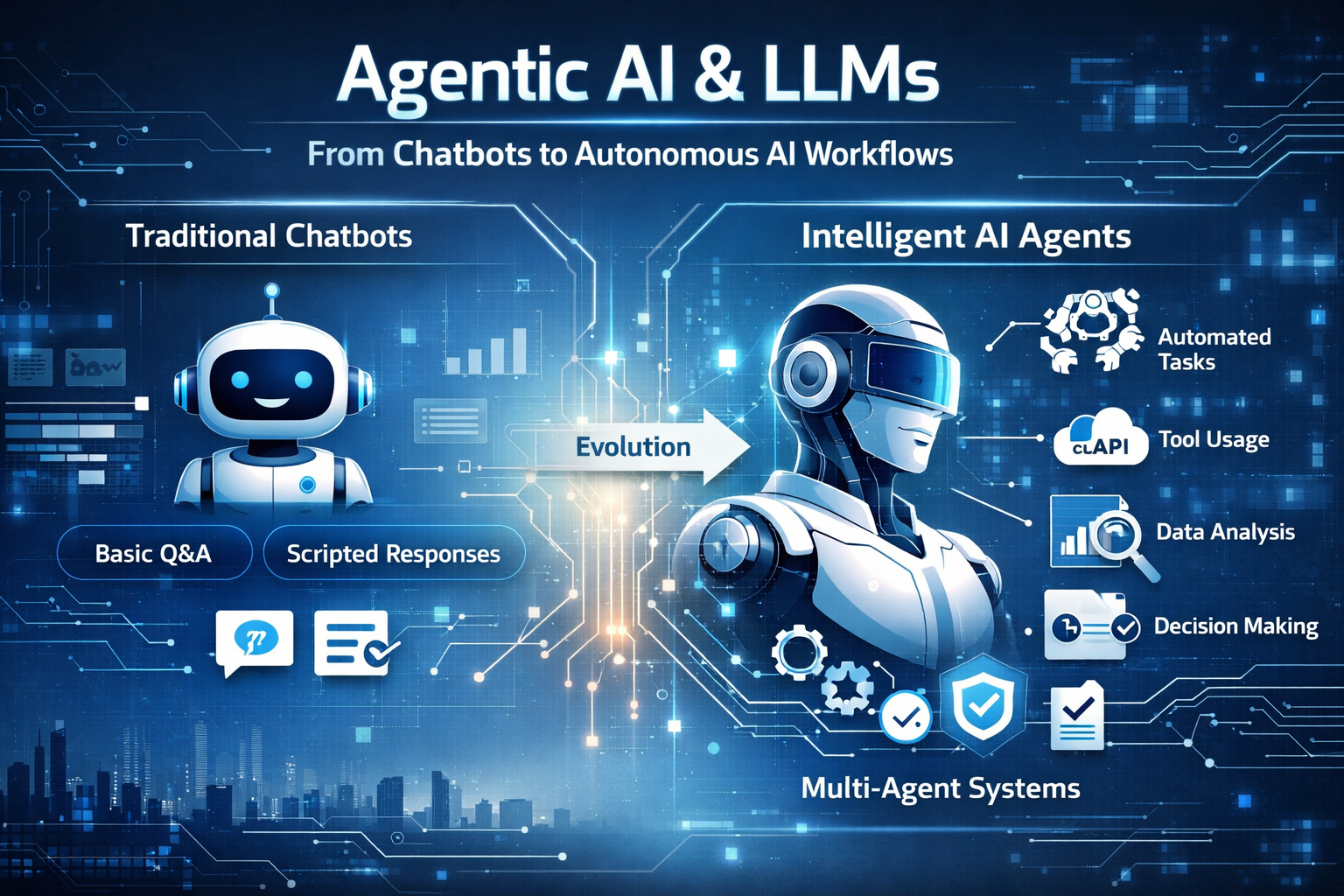
Agentic AI & LLMs: Moving Beyond Simple Chatbots to Autonomous AI Workflows
Agentic AI & LLMs: Moving Beyond Simple Chatbots to Autonomous AI Workflows
Introduction
Artificial Intelligence is undergoing a fundamental shift. While traditional chatbots powered by Large Language Models (LLMs) have transformed customer interactions, the next evolution—Agentic AI—is redefining how businesses automate workflows, make decisions, and execute complex tasks autonomously.
At Prabha Technologies, we see Agentic AI not as a trend, but as a foundational layer for next-generation enterprise systems, enabling AI to move from responding to acting.
What Is Agentic AI?
Agentic AI refers to AI systems that can:
-
Set goals
-
Plan multi-step actions
-
Use tools and APIs
-
Make decisions based on context
-
Learn from outcomes
-
Operate with minimal human intervention
Unlike traditional chatbots that respond to prompts, AI agents actively perform tasks, orchestrate workflows, and adapt dynamically.
In simple terms:
Chatbots talk. Agentic AI acts.
Role of LLMs in Agentic AI
Large Language Models (LLMs) such as GPT-based models form the cognitive core of agentic systems. However, LLMs alone are not agents.
An Agentic AI system combines:
-
LLMs (reasoning & language understanding)
-
Memory (short-term and long-term context)
-
Planning engines (task decomposition)
-
Tool usage (APIs, databases, RPA, web services)
-
Feedback loops (self-correction and optimization)
This architecture enables AI to execute end-to-end workflows, not just generate text.
From Chatbots to AI Agents: Key Differences
| Aspect | Traditional Chatbots | Agentic AI |
|---|---|---|
| Interaction | Prompt–response | Goal-driven |
| Decision-making | Limited | Autonomous |
| Task execution | None or minimal | Multi-step workflows |
| Tool usage | Rare | Native |
| Learning | Static | Adaptive |
| Enterprise readiness | Medium | High |
Real-World Use Cases of Agentic AI
1. Enterprise Process Automation
AI agents can automate:
-
Compliance checks (LIMS, HSEQ, QMS)
-
Audit preparation
-
Regulatory reporting
-
Vendor risk assessment
2. AI-Powered Operations
Agents can:
-
Monitor system logs
-
Trigger alerts
-
Fix known issues
-
Optimize workflows in real time
3. Financial & Risk Intelligence
-
Autonomous risk scoring
-
Fraud detection
-
Investment analysis
-
Policy enforcement
4. Customer & Internal Support
-
Resolve tickets end-to-end
-
Interact with CRM, ERP, HRMS
-
Schedule actions, approvals, and follow-ups
5. Multi-Agent Systems
Specialized agents collaborate:
-
Planner Agent
-
Executor Agent
-
Validator Agent
-
Compliance Agent
This mirrors human organizational structures, but at machine speed.
Why Agentic AI Matters for Businesses
Agentic AI delivers:
-
Operational efficiency
-
Reduced human dependency
-
Scalability without proportional cost increase
-
Faster decision-making
-
24/7 autonomous execution
For enterprises, this means AI as a digital workforce, not just a tool.
Challenges & Responsible Design
While powerful, Agentic AI must be designed responsibly:
-
Clear permission boundaries
-
Audit trails
-
Human-in-the-loop governance
-
Security-first architecture
-
Ethical AI policies
At Prabha Technologies, we emphasize controlled autonomy, especially in regulated industries.
The Future: AI as a Digital Colleague
The future of AI is not conversational—it is collaborative.
Agentic AI systems will:
-
Work alongside humans
-
Execute complex responsibilities
-
Learn organizational rules
-
Align with business objectives
This evolution will define Industry 5.0, where humans and intelligent agents co-create value.
How Prabha Technologies Is Leading This Shift
Prabha Technologies is actively building:
-
Agentic AI architectures
-
LLM-powered enterprise platforms
-
AI-driven compliance & quality systems
-
Autonomous workflow engines
Our focus is on secure, scalable, and domain-specific Agentic AI for industries such as healthcare, laboratories, governance, finance, and enterprise operations.
Conclusion
Agentic AI represents a paradigm shift—from AI that answers questions to AI that gets work done. Organizations that adopt agent-based systems early will gain a decisive competitive advantage in efficiency, intelligence, and scale.
The era of autonomous AI workflows has begun.
References
-
OpenAI – Planning and Tool Use in Large Language Models
-
Microsoft Research – Autonomous Agents and AI Orchestration
-
LangChain Documentation – Agent Frameworks and Tool Calling
-
Stanford HAI – Foundation Models and Autonomous Systems
-
IBM Research – AI Agents in Enterprise Automation
-
McKinsey & Company – The Economic Potential of Generative AI
 +971 54 325 5456
 Prabha Technologies |Prabha Tech



 Our expert team